
 Image 1 of 1
09 Nicaragua, Los Papales
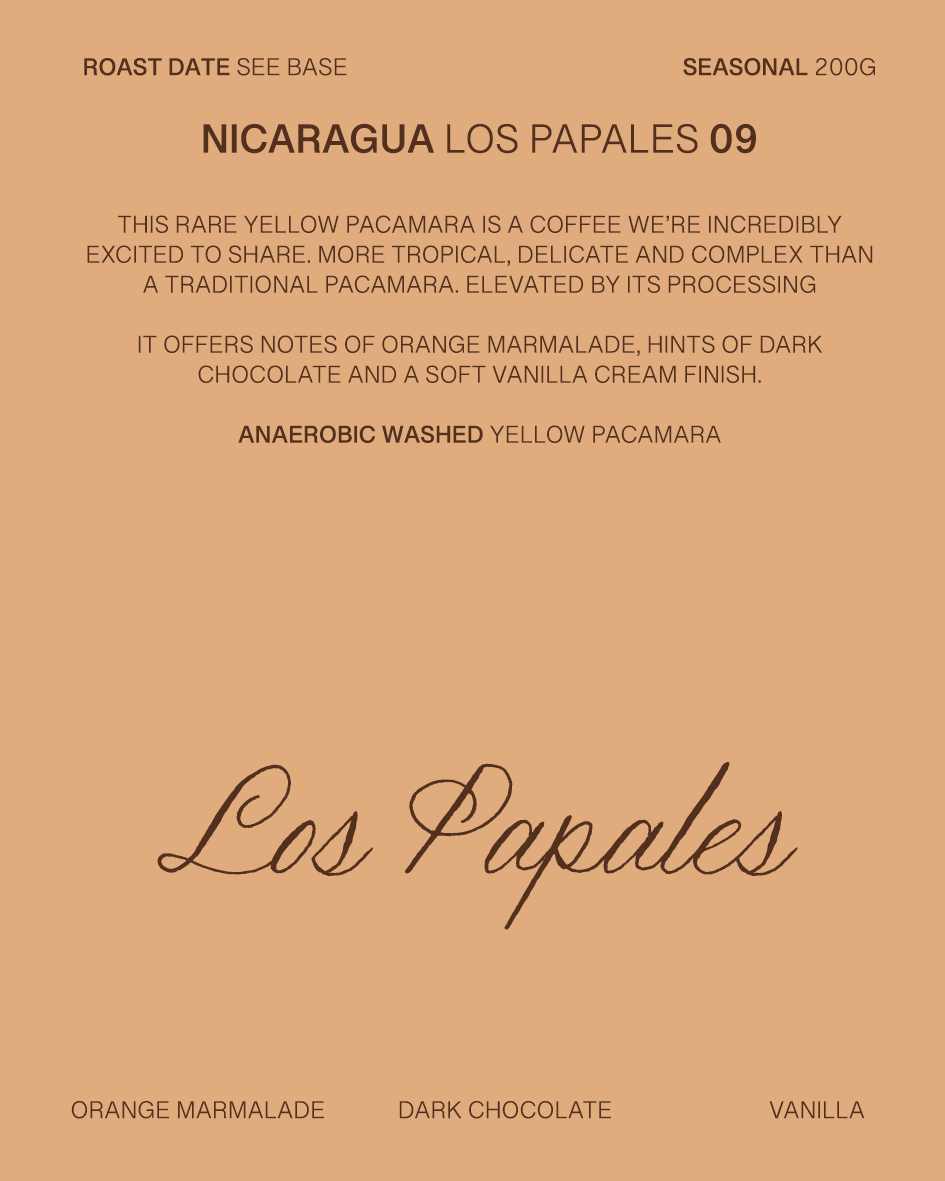
ORANGE MARMALADE, DARK CHOCOLATE, VANILLA CREAM
Release 09 is a seasonal coffee we’re incredibly excited to share. Our first ever coffee from Nicaragua.
Nicaragua isn’t an origin that has appeared on our shelves often over the years, but whenever it does, it’s something we’ve always enjoyed.
What makes this coffee particularly special is its varietal and processing.
Pacamara is one of the largest coffee varietals in the world, and also one of the trickier ones to roast. We’re drawn to it for its incredible sweetness, complexity and distinctive character.
More specifically, this is Yellow Pacamara, a much rarer expression of the varietal. Compared with traditional Pacamara, Yellow Pacamara can offer a brighter, more tropical profile, with flavours reminiscent of passionfruit and mango. The body tends to be a little lighter too, with a creamy, honey-like mouthfeel and greater clarity.
That character is further enhanced by a period of anaerobic fermentation before the coffee is washed, helping to heighten its sweetness, fruit character and complexity.
In the cup, expect plenty of tropical character, but most noticeably an almost orange marmalade-like flavour, followed by hints of dark chocolate and a creamy vanilla finish.
A very delicious and distinctive cup.
Altitude 1300 - 1500
Process Anaerobic Washed
Location Jinotega
Varietal Yellow Pacamara
The López family established their first coffee plantations over a century ago under the guidance of the family patriarch, Mr Vicente López López, a Nicaraguan citizen of Spanish origin. These early plantations were set in the mountainous Datanlí region of Jinotega. His son, Vicente López Herrera, continued the tradition, founding his own farm, Betania, which remained the family estate until it was confiscated during the Nicaraguan conflict in the 1980s. Today, the family operates two farms, Los Papales and Betania (named in honour of the original holding), cultivating both traditional and improved coffee varieties.
Los Papales lies five kilometres from Jinotega city on the slopes of Cerro Chimborazo, which rises to 1,688 metres above sea level and is among the highest peaks of the Cordillera Isabelia. The farm’s distinctive topography, cloud-forest climate, and commitment to agro-ecological management and biodiversity conservation provide ideal conditions for high-quality Arabica coffees, including lots classified as SHG and SHB.
Finca Los Papales covers 297 manzanas(210 ha) at elevations between 1,300 and 1,500 metres above sea level. The principal varieties include Caturra, Yellow and Red Catuaí, Java, and Pacamara. Harvest runs from January to late March, with ripe cherries handpicked at peak maturity, primarily by families from neighbouring communities. The farm provides permanent employment for around 120 people, rising to approximately 450 during the harvest.
Processing begins with conversion of the cherry to parchment coffee at an eco-efficient wet mill designed to minimise water use. The mill is equipped to handle washed coffees—both fermented and unfermented—as well as semi-washed styles. Drying takes place in greenhouses and under poly-shade structures to ensure slow, even dehydration that promotes product safety, longer shelf life, and reliable traceability. The estate also houses the equipment and machinery required to mill and prepare coffee to export-ready specifications, ensuring end-to-end quality control and full traceability within the family’s facilities.
Finca Los Papales is certified by the Rainforest Alliance, supporting alignment with international norms and the requirements of the Sustainable Agriculture Network. The farm also maintains a strong social commitment to its community. An on-site school serves about 65 children from infancy through sixth grade, offering free education to employees’ children and those from nearby communities, along with school supplies, daily meals, and participation in special activities such as Children’s Day, Mother’s Day, and graduation ceremonies. Educational oversight is provided by Nicaragua’s Ministry of Education (MINED). A health centre on the farm, supervised by the Ministry of Health (MINSA), offers free consultations for employees and local residents, including immunisation services for children, gynaecological care for women, and general medical attention.
ORANGE MARMALADE, DARK CHOCOLATE, VANILLA CREAM
Release 09 is a seasonal coffee we’re incredibly excited to share. Our first ever coffee from Nicaragua.
Nicaragua isn’t an origin that has appeared on our shelves often over the years, but whenever it does, it’s something we’ve always enjoyed.
What makes this coffee particularly special is its varietal and processing.
Pacamara is one of the largest coffee varietals in the world, and also one of the trickier ones to roast. We’re drawn to it for its incredible sweetness, complexity and distinctive character.
More specifically, this is Yellow Pacamara, a much rarer expression of the varietal. Compared with traditional Pacamara, Yellow Pacamara can offer a brighter, more tropical profile, with flavours reminiscent of passionfruit and mango. The body tends to be a little lighter too, with a creamy, honey-like mouthfeel and greater clarity.
That character is further enhanced by a period of anaerobic fermentation before the coffee is washed, helping to heighten its sweetness, fruit character and complexity.
In the cup, expect plenty of tropical character, but most noticeably an almost orange marmalade-like flavour, followed by hints of dark chocolate and a creamy vanilla finish.
A very delicious and distinctive cup.
Altitude 1300 - 1500
Process Anaerobic Washed
Location Jinotega
Varietal Yellow Pacamara
The López family established their first coffee plantations over a century ago under the guidance of the family patriarch, Mr Vicente López López, a Nicaraguan citizen of Spanish origin. These early plantations were set in the mountainous Datanlí region of Jinotega. His son, Vicente López Herrera, continued the tradition, founding his own farm, Betania, which remained the family estate until it was confiscated during the Nicaraguan conflict in the 1980s. Today, the family operates two farms, Los Papales and Betania (named in honour of the original holding), cultivating both traditional and improved coffee varieties.
Los Papales lies five kilometres from Jinotega city on the slopes of Cerro Chimborazo, which rises to 1,688 metres above sea level and is among the highest peaks of the Cordillera Isabelia. The farm’s distinctive topography, cloud-forest climate, and commitment to agro-ecological management and biodiversity conservation provide ideal conditions for high-quality Arabica coffees, including lots classified as SHG and SHB.
Finca Los Papales covers 297 manzanas(210 ha) at elevations between 1,300 and 1,500 metres above sea level. The principal varieties include Caturra, Yellow and Red Catuaí, Java, and Pacamara. Harvest runs from January to late March, with ripe cherries handpicked at peak maturity, primarily by families from neighbouring communities. The farm provides permanent employment for around 120 people, rising to approximately 450 during the harvest.
Processing begins with conversion of the cherry to parchment coffee at an eco-efficient wet mill designed to minimise water use. The mill is equipped to handle washed coffees—both fermented and unfermented—as well as semi-washed styles. Drying takes place in greenhouses and under poly-shade structures to ensure slow, even dehydration that promotes product safety, longer shelf life, and reliable traceability. The estate also houses the equipment and machinery required to mill and prepare coffee to export-ready specifications, ensuring end-to-end quality control and full traceability within the family’s facilities.
Finca Los Papales is certified by the Rainforest Alliance, supporting alignment with international norms and the requirements of the Sustainable Agriculture Network. The farm also maintains a strong social commitment to its community. An on-site school serves about 65 children from infancy through sixth grade, offering free education to employees’ children and those from nearby communities, along with school supplies, daily meals, and participation in special activities such as Children’s Day, Mother’s Day, and graduation ceremonies. Educational oversight is provided by Nicaragua’s Ministry of Education (MINED). A health centre on the farm, supervised by the Ministry of Health (MINSA), offers free consultations for employees and local residents, including immunisation services for children, gynaecological care for women, and general medical attention.