
 Image 1 of 1
10 Ethiopia, Gotiti
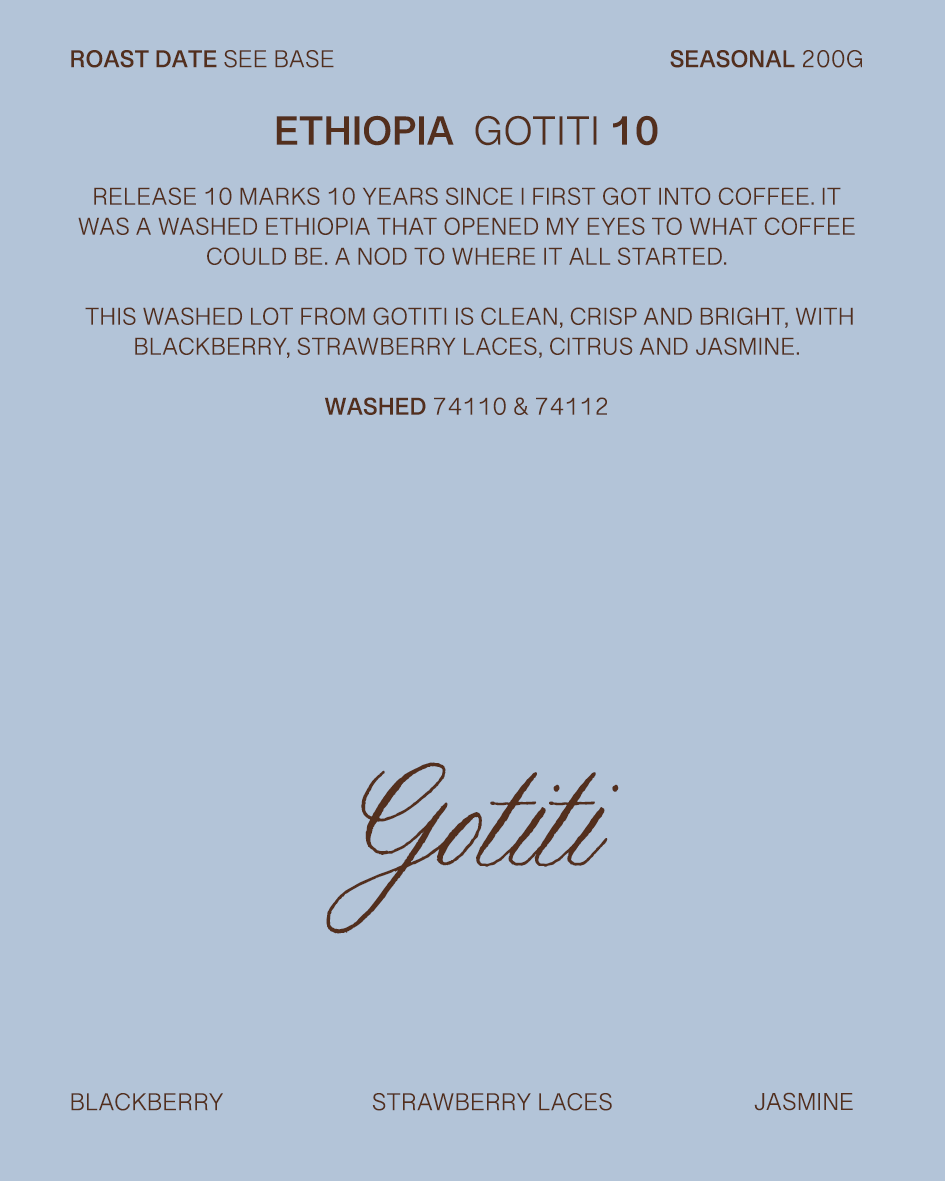
Release 10. Ten years in coffee.
This release is a particularly special one for me.
Ten years ago, I drank my first washed Ethiopian coffee. At the time, I had no idea quite what an impact it would have on me. I’d simply never tasted coffee like it before. Bright, floral, clean and beautifully acidic. It completely changed my perception of what coffee could be.
That cup was really the beginning.
From there, I started exploring different origins, processes and varietals, and over the last decade coffee has continued to evolve at an incredible pace. We’ve seen increasingly advanced processing, new varietal mutations and coffees being grown in places you’d never traditionally associate with them.
But there’s one thing I always seem to circle back to: fresh crop washed Ethiopia.
So for Release 10, marking my tenth year in coffee, it felt right to return to where it all started.
This is also the first washed Ethiopian coffee we’ve had the opportunity to release at still. and we’ve bought plenty of it. Rather than being a fleeting release, I want this coffee to become a staple on our menu over the next few months.
The coffee is traditionally washed, giving us the clarity and vibrancy I remember falling in love with all those years ago.
Expect a bright, crisp cup with strawberry laces and blackberry, followed by a honey-like sweetness, fresh citrus and delicate jasmine florals.
Release 10. A little nod to the coffee that started it all.
Altitude
2000 - 2100
Process
Washed
Location
South Region, Gedeo Zone, Gedeb wereda, Gotiti Kebele
Varietal
74110,74112
Eva Gotiti Wet Coffee Processing Station is a coffee washing facility located in the South Region of Ethiopia, within the Gedeo Zone, Gedeb Wereda, Gotiti Kebele.
This station was established in 2022 on a two-hectare plot of land. Since its inception, it has steadily developed, with long-term plans for expansion, including underground water sourcing, the installation of artificial dryers, site expansion, and solar tunnel installation.
The station employs six permanent staff members, six seasonal workers, and 244 temporary workers. Annually, the station processes approximately 500–600 tons of cherry coming from 868 farmers and their small coffee gardens. Primarily grown are coffee varieties such as 7454, 74110, 7440, and 74112.
The station follows strict water management and traceability practices, reducing water use, separating coffee pulp from wastewater, and implementing efficient record-keeping from farm to export.
Eva Gotiti Wet Coffee Processing Station follows the washed coffee processing method, which involves several detailed steps to ensure premium quality. The process begins with sieving to remove debris like leaves and stones. The cherries are then washed and pulped to separate the fruit from the beans. Next, they undergo fermentation in water tanks under controlled temperatures to remove the mucilage. After fermentation, the beans are washed again before being dried in parchment form. Quality control is maintained by monitoring temperature, bean size, color, and odor to ensure consistency. Coffee traceability is also a priority, ensuring each lot is recorded, processed, stored, and shipped separately.
The station is committed to environmental and social responsibility, providing coffee seedlings to the community, financial support to underprivileged farmers, and premium payments based on coffee deliveries. These efforts not only enhance sustainability but also strengthen the relationships between farmers and the washing station.
Steps in the Wet Coffee Processing Method:
1) Cleaning Cherry – Remove debris like leaves and stones.
2) Washing – Clean the coffee cherries with water
3) Pulping – Separate the fruit and skins from the beans.
4) Fermenting – Remove the mucilage in water tanks at controlled temperatures.
5) Second Washing – clean the beans with more water.
6) Drying – Taken to raised beds where it is turned regularly in the day and covered in the midday heat and at night. Drying is around 10 - 14 days.
7) Storage – Fully dried parchment is packed and stored for about 20 days before shipping and kept as separate lots until it is cupped and assessed.
Release 10. Ten years in coffee.
This release is a particularly special one for me.
Ten years ago, I drank my first washed Ethiopian coffee. At the time, I had no idea quite what an impact it would have on me. I’d simply never tasted coffee like it before. Bright, floral, clean and beautifully acidic. It completely changed my perception of what coffee could be.
That cup was really the beginning.
From there, I started exploring different origins, processes and varietals, and over the last decade coffee has continued to evolve at an incredible pace. We’ve seen increasingly advanced processing, new varietal mutations and coffees being grown in places you’d never traditionally associate with them.
But there’s one thing I always seem to circle back to: fresh crop washed Ethiopia.
So for Release 10, marking my tenth year in coffee, it felt right to return to where it all started.
This is also the first washed Ethiopian coffee we’ve had the opportunity to release at still. and we’ve bought plenty of it. Rather than being a fleeting release, I want this coffee to become a staple on our menu over the next few months.
The coffee is traditionally washed, giving us the clarity and vibrancy I remember falling in love with all those years ago.
Expect a bright, crisp cup with strawberry laces and blackberry, followed by a honey-like sweetness, fresh citrus and delicate jasmine florals.
Release 10. A little nod to the coffee that started it all.
Altitude
2000 - 2100
Process
Washed
Location
South Region, Gedeo Zone, Gedeb wereda, Gotiti Kebele
Varietal
74110,74112
Eva Gotiti Wet Coffee Processing Station is a coffee washing facility located in the South Region of Ethiopia, within the Gedeo Zone, Gedeb Wereda, Gotiti Kebele.
This station was established in 2022 on a two-hectare plot of land. Since its inception, it has steadily developed, with long-term plans for expansion, including underground water sourcing, the installation of artificial dryers, site expansion, and solar tunnel installation.
The station employs six permanent staff members, six seasonal workers, and 244 temporary workers. Annually, the station processes approximately 500–600 tons of cherry coming from 868 farmers and their small coffee gardens. Primarily grown are coffee varieties such as 7454, 74110, 7440, and 74112.
The station follows strict water management and traceability practices, reducing water use, separating coffee pulp from wastewater, and implementing efficient record-keeping from farm to export.
Eva Gotiti Wet Coffee Processing Station follows the washed coffee processing method, which involves several detailed steps to ensure premium quality. The process begins with sieving to remove debris like leaves and stones. The cherries are then washed and pulped to separate the fruit from the beans. Next, they undergo fermentation in water tanks under controlled temperatures to remove the mucilage. After fermentation, the beans are washed again before being dried in parchment form. Quality control is maintained by monitoring temperature, bean size, color, and odor to ensure consistency. Coffee traceability is also a priority, ensuring each lot is recorded, processed, stored, and shipped separately.
The station is committed to environmental and social responsibility, providing coffee seedlings to the community, financial support to underprivileged farmers, and premium payments based on coffee deliveries. These efforts not only enhance sustainability but also strengthen the relationships between farmers and the washing station.
Steps in the Wet Coffee Processing Method:
1) Cleaning Cherry – Remove debris like leaves and stones.
2) Washing – Clean the coffee cherries with water
3) Pulping – Separate the fruit and skins from the beans.
4) Fermenting – Remove the mucilage in water tanks at controlled temperatures.
5) Second Washing – clean the beans with more water.
6) Drying – Taken to raised beds where it is turned regularly in the day and covered in the midday heat and at night. Drying is around 10 - 14 days.
7) Storage – Fully dried parchment is packed and stored for about 20 days before shipping and kept as separate lots until it is cupped and assessed.