
 Image 1 of 1
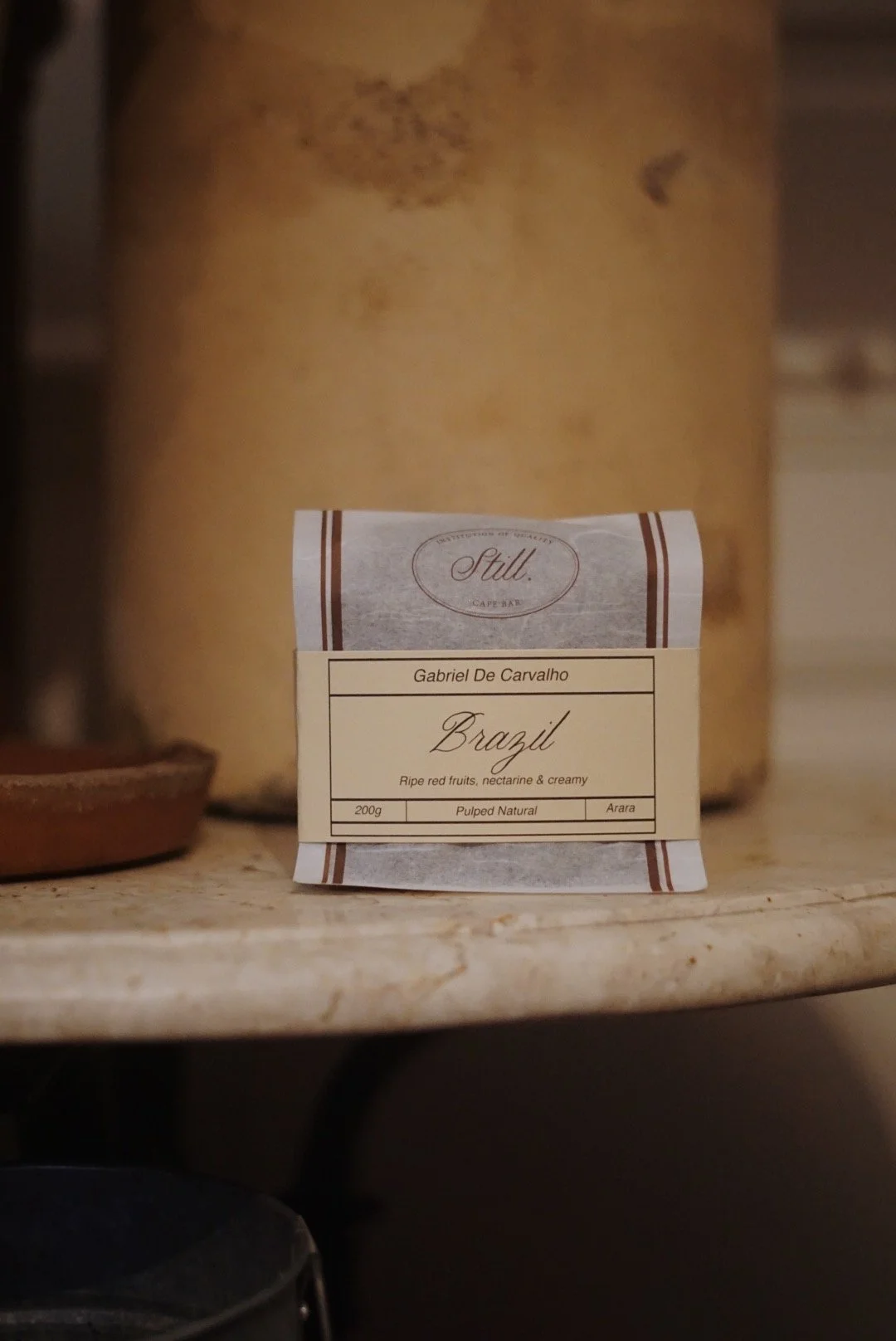
Brazil, Gabriel De Carvalho
Ripe red fruits, nectarine & creamy
Perhaps the finest brazil we have ever ran. Brazils are often sourced as blends or base coffees. Whilst they deliver on this they often get the reputation of being “boring, dull & flat” — This Brazil is far from that. Scoring a whopping 87+ SCA points. Which is huge for Brazil.
This coffee is a Pulped Natural Arara varietal. Pulped Natural is the process. Similar to honey processing. This is where the skin is stripped from the cherry and its left to ferment with the mucilage. Making it cleaner than a natural but sweeter than washed. A real middle ground of processing.
Arara is a modern Brazliian varietal.
In the cup youll find all the sweetness and balance you would expect from Brazil, however beyond that there is a depth and complexity not often associated with brazil. Softer character and gentle fruits lead to a brighter expression.
This coffee can be brewed every way including filter.
Gabriel De Carvalho
Fazenda Cachoeira da Grama has been in the Carvalho Dias family since 1890. Gabriel de Carvalho Dias, son of the owner, Lindolpho de Carvalho Dias, was responsible for managing the property until 2016.
The farm serves as a processing center and a hub for research and development, focusing on variety selection, harvesting, processing, and drying methods. With a 100% focus on quality and continuous improvement, the farm aims to become a reference in specialty coffee production.
Cachoeira da Grama is locates in Vale Da Grama, it spans 411 hectares, with 84 hectares dedicated to coffee cultivation. Situated at 1,250 m.a.s.l, the farm grows varieties such as Yellow & Red Bourbon, Yellow & Red Catuaí, Yellow Catucaí, Mundo Novo, and Arara. The climate is ideal for producing high-quality coffee, with annual precipitation ranging between 1,800 and 2,000 mm and an average temperature of 19°C.
Altitude 1,250
Location / Farm Vale da Grama
Temperature 13 – 25 oC
Botanical Cultivars Arara
Soil Characteristics Volcanic soil
Annual Rainfall 1800-2000 mm
Social and environmental sustainability are central to the farm's management practices. Lindolpho de Carvalho Dias initiated a program to plant native species, promoting ecological balance. Additionally, the farm provides facilities for its employees, including a school, a club, and a full-sized soccer field.
This Arara lot was hand-picked, with extended cloth placed on the ground to prevent the beans from coming into direct contact with the soil. Once harvested, the coffee cherries are dried on raised beds and covered patios until they reach 20% moisture content. They are then transferred to mechanical dryers to reduce the moisture level to 11%. Finally, the coffee is stored in a controlled warehouse environment, free from odors and with regulated humidity levels to preserve its quality
Ripe red fruits, nectarine & creamy
Perhaps the finest brazil we have ever ran. Brazils are often sourced as blends or base coffees. Whilst they deliver on this they often get the reputation of being “boring, dull & flat” — This Brazil is far from that. Scoring a whopping 87+ SCA points. Which is huge for Brazil.
This coffee is a Pulped Natural Arara varietal. Pulped Natural is the process. Similar to honey processing. This is where the skin is stripped from the cherry and its left to ferment with the mucilage. Making it cleaner than a natural but sweeter than washed. A real middle ground of processing.
Arara is a modern Brazliian varietal.
In the cup youll find all the sweetness and balance you would expect from Brazil, however beyond that there is a depth and complexity not often associated with brazil. Softer character and gentle fruits lead to a brighter expression.
This coffee can be brewed every way including filter.
Gabriel De Carvalho
Fazenda Cachoeira da Grama has been in the Carvalho Dias family since 1890. Gabriel de Carvalho Dias, son of the owner, Lindolpho de Carvalho Dias, was responsible for managing the property until 2016.
The farm serves as a processing center and a hub for research and development, focusing on variety selection, harvesting, processing, and drying methods. With a 100% focus on quality and continuous improvement, the farm aims to become a reference in specialty coffee production.
Cachoeira da Grama is locates in Vale Da Grama, it spans 411 hectares, with 84 hectares dedicated to coffee cultivation. Situated at 1,250 m.a.s.l, the farm grows varieties such as Yellow & Red Bourbon, Yellow & Red Catuaí, Yellow Catucaí, Mundo Novo, and Arara. The climate is ideal for producing high-quality coffee, with annual precipitation ranging between 1,800 and 2,000 mm and an average temperature of 19°C.
Altitude 1,250
Location / Farm Vale da Grama
Temperature 13 – 25 oC
Botanical Cultivars Arara
Soil Characteristics Volcanic soil
Annual Rainfall 1800-2000 mm
Social and environmental sustainability are central to the farm's management practices. Lindolpho de Carvalho Dias initiated a program to plant native species, promoting ecological balance. Additionally, the farm provides facilities for its employees, including a school, a club, and a full-sized soccer field.
This Arara lot was hand-picked, with extended cloth placed on the ground to prevent the beans from coming into direct contact with the soil. Once harvested, the coffee cherries are dried on raised beds and covered patios until they reach 20% moisture content. They are then transferred to mechanical dryers to reduce the moisture level to 11%. Finally, the coffee is stored in a controlled warehouse environment, free from odors and with regulated humidity levels to preserve its quality